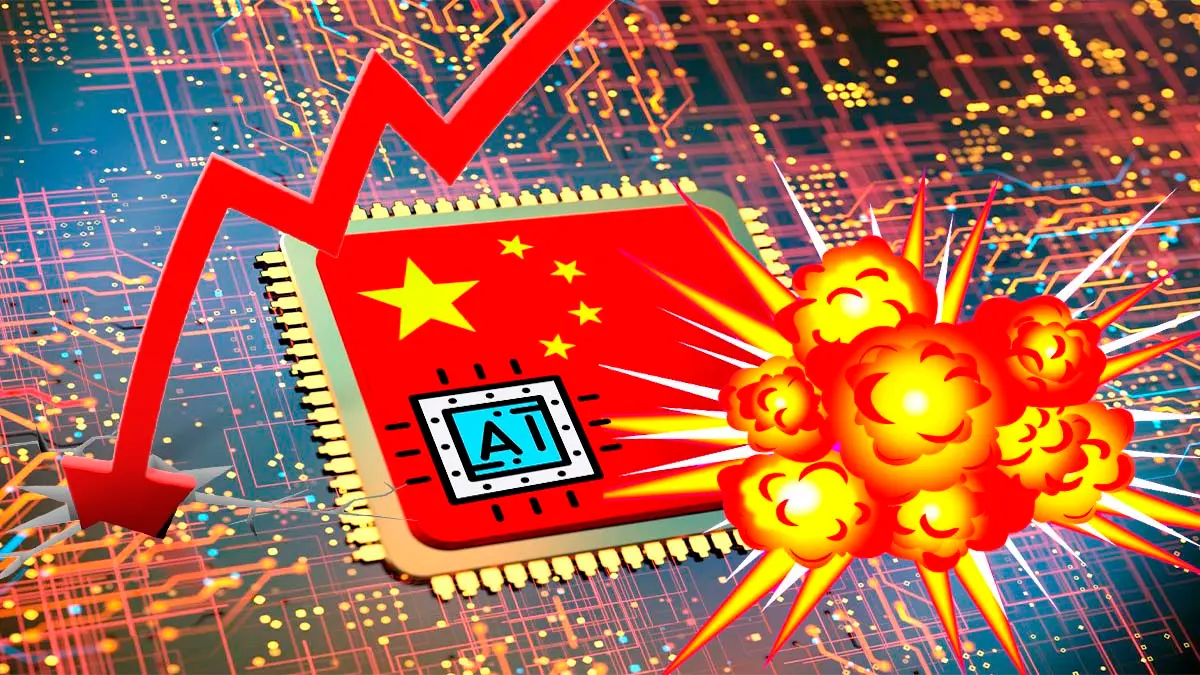
As global financial markets show signs of instability, in China The AI bubble burst, hitting the highly inflated valuations of its most promising companies hard, after the lack of clarity about real demand for AI services and the growing restrictions from other countries on Chinese exports unleashed a wave of mass selling.
According to a Reuters analysis, in less than four months the STAR 50 index, which gathers China’s AI and chip companies, fell 40%, wiping out about $480 billion in market value, a plunge that ended a two-year rally driven by the government’s promises of stimulus, and that also dragged down the CSI 300, the index of the country’s leading firms, which is down about 20% from its June peak.
Why the AI Bubble Exploded in China
To describe the gravity of the situation, Beijing-based fund manager Dong Baozhen explained that “the stock market later turned into a speculative frenzy”, and added that “now we are seeing the bubble burst.”
In the Chinese case there wasn’t a single trigger, but a combination of factors, such as extremely inflated stock prices, the tax burden, and the constant threat that the United States and other countries will ban Chinese equipment in their data centers.
This vulnerability is critical, because according to Goldman Sachs AI firms represent 42% of the total market value in China and 57% of the money moving in the mainland and Hong Kong stock markets, and as the market is dominated by retail investors, almost no one has managed to dodge the losses.
The Hardest-Hit Companies, Including GPU Makers
The collapse hit directly the companies that were crowd favorites, such as the robotics maker Unitree, whose IPO generated so much enthusiasm that demand for shares exceeded 8,000 times the offer, and which since August has lost half of its value.
In a similar situation is CXMT, the largest Chinese memory maker, which has shed more than a quarter of its value in the last month, while the GPU makers MetaX and Moore Threads, which had surged 700% and 400% on their IPO debuts last year, have lost half their value since July.
Regarding the impact on new investments, Hong Hao, partner and chief investment officer at Lotus Asset Management in Hong Kong, said that “what is happening now is going to slow many companies trying to go public”.
The AI Bubble in China Might Not Have Bottomed Out Yet
Despite the drop, Chinese tech shares still trade at lofty levels, with the STAR 50 trading at about 100 times its annual earnings, after peaking near 250 times, while the United States’ Nasdaq 100 trades at only about 30 times, fueling fears that the rout isn’t over yet; in fact, Morgan Stanley forecasts another 10% to 15% drop before Chinese equities hit bottom.
These firms anticipate enormous infrastructure spending, as Alphabet plans to devote between $195 billion and $205 billion to chips and data centers, and Amazon about $220 billion, pouring more money into infrastructure than their own businesses generate to meet a cloud-services demand that keeps growing.
The collapse has also raised concerns about new investments; as Hong Hao, partner and CIO at Lotus Asset Management in Hong Kong, noted that “what is happening now will slow many of the companies attempting to list”.
China’s Government Measures and What Comes Next
The rush of investors collides with Beijing’s efforts to curb volatility, as the government had limited lending operations and high-frequency automated trading, and even state-backed investors stepped out to sell shares during rallies to calm sentiment.
In the United States, by contrast, tech stocks retreated much more modestly, with a 6% drop in the Nasdaq from its three-week high, though all eyes are on the results Microsoft, Alphabet, and Amazon report this week.
Yet several experts believe that pushing the tech sector at all costs ended up distorting the market, and Leo Wang, partner at Qianchuang Capital in Beijing, explained that “placing too much emphasis on technological content in major indices leads to a misallocation, and even a distortion, in capital behavior,” concluding that “this created a grave bubble in some sectors and a serious drain of money in others.”

To close, Wang Zhuo, partner at Shanghai Zhuozhu Investment Management, warned that “like all other Chinese manufacturers, chip producers and AI suppliers will eventually end up in a price war,” and he summed up that in these cases there are no exceptions, because “all bubbles eventually burst.”
