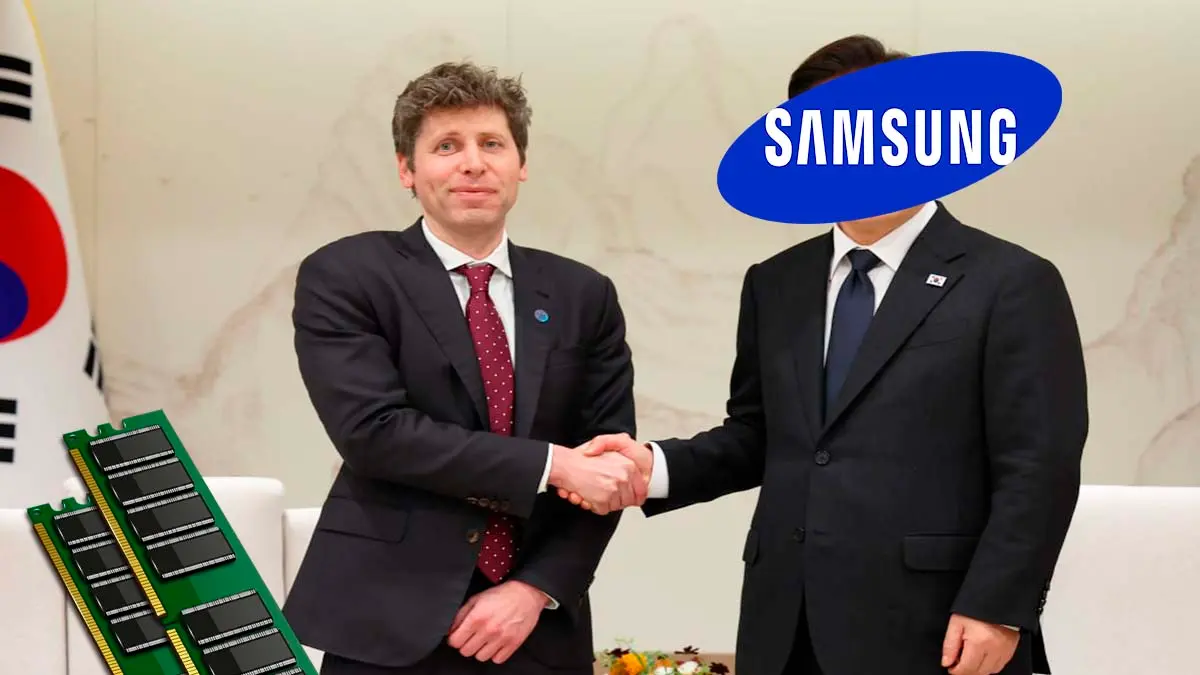
Amid what has been described as a hardware crisis, with RAM as one of its primary victims, OpenAI’s chief executive and head of ChatGPT, Sam Altman traveled to South Korea to meet with nearly 50 senior Samsung executives, according to Bloomberg, in a gathering that focused on memory supply for the company’s data centers, just days after he called having RAM in personal computers “terrible.”
The meeting is not incidental, because the tech landscape assigns substantial weight to that country, given that Samsung and SK Hynix account for about 63% of global DRAM revenue and roughly 83% of HBM revenue, the high-bandwidth memory essential for artificial intelligence, according to Counterpoint Research, and with short-term component shortages looming, the main technology players are reshaping their commercial strategies and are compelled to negotiate alliances and contracts directly with manufacturers.
The ChatGPT Chief’s Meeting with Samsung and the Tech Sector’s Strategies
During this meeting at Samsung’s Resource Development Center in Yongin, the ChatGPT chief confirmed that discussions touched on “the direction of AI technology development and its potential applications”, while the focal point of the gathering was the letter of intent the two companies signed to cooperate on AI infrastructure, including the supply of memory for Stargate, OpenAI’s data-center project, though no new agreement was announced at this time.
The global shortage of components is affecting the entire industry, because the data centers that process artificial intelligence compete directly for memory with PC manufacturers, smartphone makers, and other electronics, and according to TrendForce, DRAM supply will be 1% to 2% below demand in 2026, with a widening gap in 2027.
Since building new factories takes years, Micron warned that this shortage could stretch into 2028, which explains why the ChatGPT chief and other major companies are traveling to South Korea to negotiate long-term supplies with giants like Samsung and SK Hynix, which control the vast majority of the world’s specialty memory.
In response to this crisis, chip and memory manufacturers have begun reorganizing production to prioritize data centers over consumer demand, and firms like AMD have also sent their top executives to negotiate directly with Korean suppliers, as demonstrated this month when its CEO, Lisa Su, traveled to Korea to secure more HBM memory and, according to Tom’s Hardware, stated that it is important to plan three to five years ahead with their partners.
At the same time, Samsung and SK Hynix have started upgrading their factories in China, and while these particular improvements focus on NAND flash memory rather than RAM directly, they illustrate how the entire supply chain is being reshaped to feed the large data centers.
The competition for memory does not stop at cloud computing, because Elon Musk asserted on X that “RAM needs for robots will surpass everything else on Earth”, in response to a Counterpoint Research analysis projecting that humanoid-robot memory demand could multiply by 20 by 2030, a figure Musk dismissively labeled “stupid” for underestimating the demand, according to Yahoo Finance, though even with that projection the robots’ consumption would still be well below 1% of current DRAM production.
This outlook makes it clear that the current shortage is not a temporary hiccup but a deep restructuring of the technology industry, where the major players aggressively compete for each available component and PC users end up paying a premium for the memory they require.
The Controversy Over RAM in Computers and User Fear
In the midst of this shortage scenario, a few days ago we noted that the ChatGPT chief sparked significant controversy by labeling as “quite terrible” the idea that people have RAM in their personal computers, arguing that it is inefficient for users to utilize that memory only about 5% of the time, and proposing that it would be better to leverage it in data centers.
This stance drew harsh criticism within the tech community, with outlets like Gizmodo suggesting that Altman is simply protecting OpenAI’s business model, because by relying on closed cloud-based systems, the company benefits from monthly subscriptions to use tools remotely rather than running them on users’ own machines.

Finally, as we reported in the linked note, these statements fueled enthusiasts’ fears of losing control and ownership of personal hardware, and now that the ChatGPT chief travels to meet one of the world’s largest memory manufacturers, that fear gains ground in a future where people abandon owning their devices in favor of renting cloud computing, under the questionable premise that artificial intelligence always utilizes memory more efficiently than gaming or everyday work.
