Microsoft announced this week the most significant update to DirectX ray tracing since the launch of DirectX Raytracing (DXR) in 2018, via the DirectX 12 Agility SDK 1.722 preview, and in a demo using a Radeon RX 9070 the memory used by acceleration structures dropped by almost 90%, although the company itself notes that those figures should not be expected in today’s games.
The update aims to reduce the processing and memory cost of DirectX ray tracing in games with detailed environments and animated objects, since it changes the habit of rebuilding large data structures every time something moves by using a technique that splits 3D objects into small groups and updates only the areas that change from frame to frame.
DirectX ray tracing demo results and compatibility with leading brands
Microsoft explained that the update introduces Clustered Geometry, which divides 3D models into small groups, and Partitioned Top-Level Acceleration Structures (PTLAS), which applies a concept similar to entire scenes, together with the possibility that the graphics card itself can build and manage these structures.
The central goal is to reduce one of the most persistent problems in games with massive environments: the high processing and memory cost of ray tracing, because with the traditional method every time an object moves or the geometry changes you have to recalculate and rebuild large data structures from scratch, which can cause significant performance losses.
With the new approach, developers can split complex 3D models into groups of up to 256 triangles and 256 vertices, so that the system reuses sections that did not change and only updates those that underwent modifications, something that can ease the load in open-world games with moving objects and real-time geometry streaming.
To demonstrate how it works, Microsoft used a Radeon RX 9070 in a testing environment, where a scene with the traditional reconstruction method ran at barely 1.2 frames per second (FPS) and with Clustered Geometry rose to 79 FPS, which is roughly 66 times faster.
The time the GPU takes to construct these structures dropped from 788 ms to 3.11 ms and the ray tracing time fell from 72.6 ms to 9.27 ms, while the total memory usage of the structures went from 7,519 MiB to 774 MiB, a saving of almost 90%, where memory for animated objects dropped from 6,794 MiB to 244 MiB.
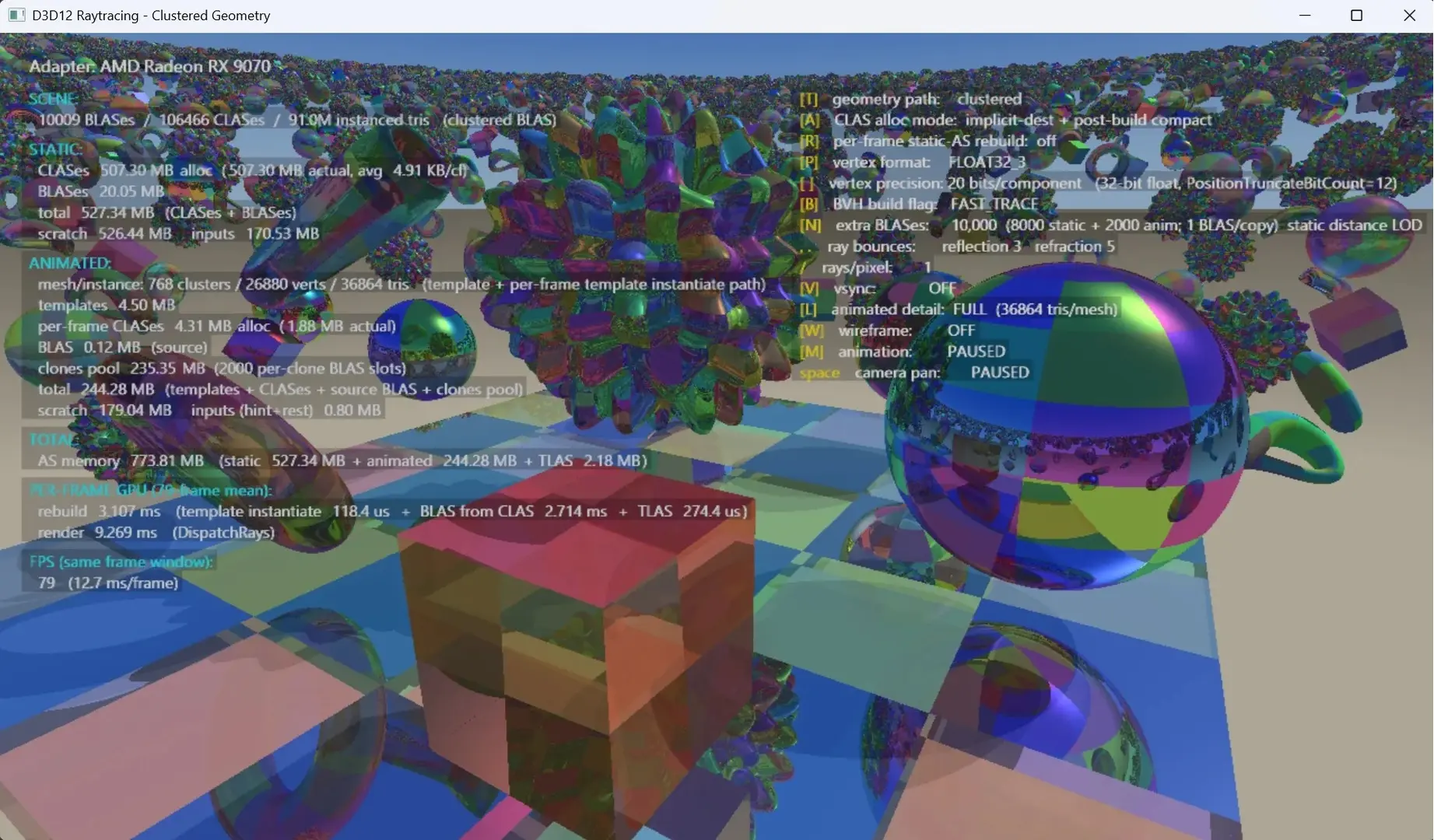
Microsoft stated that these features do not require new hardware beyond the existing ray tracing, and NVIDIA confirmed support for all GeForce RTX, which according to VideoCardz includes the 20-series, while AMD offers it on the Radeon RX 9000, Intel on the Arc B series and on the Core Ultra 200V and Series 3, and Qualcomm plans it for the Snapdragon X2 in the first half of 2027, though Microsoft notes that support on some older ray-tracing-capable cards is still to be determined.
Experimental status of the tools and the path forward for the industry
The update also brings NVIDIA’s RTX Mega Geometry technology to DirectX, which is already adopted by Gears of War: E-Day, and that provides developers with a common avenue to work with NVIDIA, AMD, and Intel cards without relying on a single-brand solution.
Clustered Geometry and PTLAS are currently experimental features available in the DirectX 12 Agility SDK 1.722 preview version and with Shader Model 6.10, so developers need compatible drivers and Windows’ Developer Mode to enable them.
Microsoft clarified that the results depend on scene complexity, configuration, and GPU, and that during the construction of the structures more temporary memory is required, although the final memory footprint is much smaller.
The company has not yet said when the final version will arrive, and warns that the demo results should not be interpreted as expected improvements for current games, which would need to implement the feature to benefit from DirectX ray tracing.
Microsoft and NVIDIA also released sample projects, such as a forest with path tracing that brings together more than 60 million plants across 25 square kilometers, a sign of where this technology is headed as games begin to adopt it.
