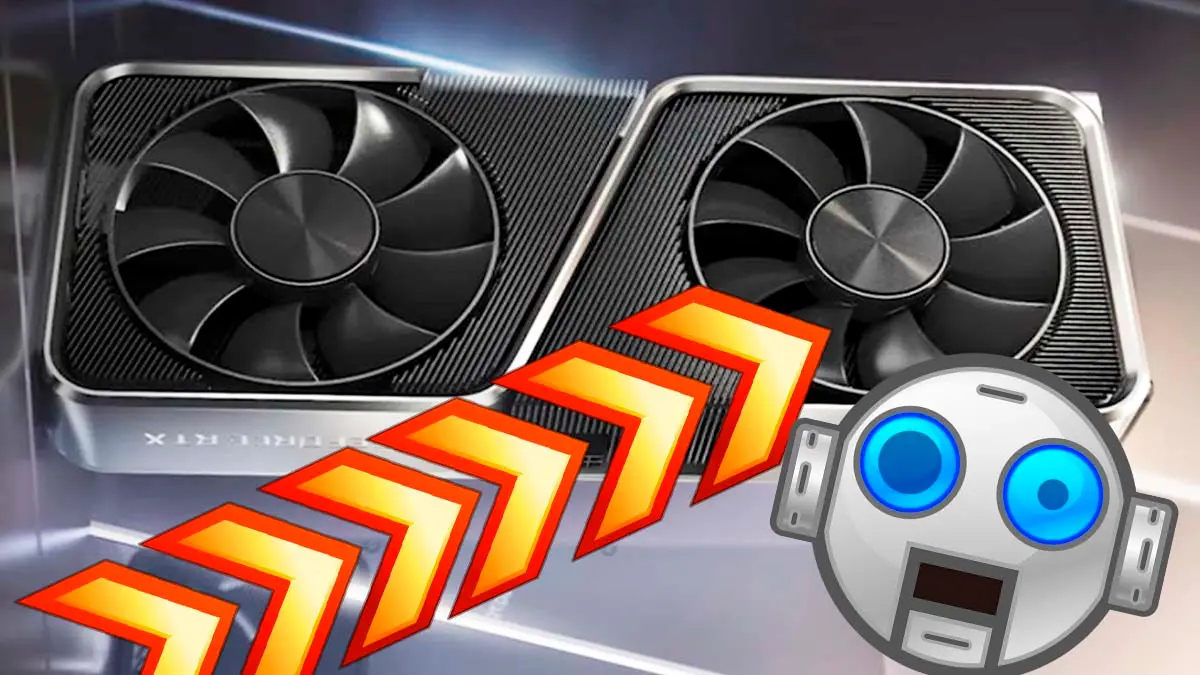
The NVIDIA GeForce RTX 30 series graphics cards, built on the Ampere architecture, hide a substantial potential for hidden compute that can now be leveraged thanks to a new open-source project published on GitHub by user Zagitta, which doubles their speed in certain artificial intelligence tasks, although it does not improve gaming performance.
It is a free tool called GPU Unlock that enables unlocking this power without modifying the BIOS or altering the official drivers, removing a speed cap that NVIDIA applies to consumer RTX 30 GPUs for certain calculations—a limit that does not exist on professional cards using the same chips.
The major speed improvements in AI benchmarks
The tool operates as a Linux kernel module that runs just before the NVIDIA driver is loaded, combining an unlocking technique that was previously used on CMP cards—the models NVIDIA produced for cryptocurrency mining—so for now it is primarily aimed at Linux users.
The best part of this solution is that it performs a function-level reset (FLR) to modify the speed selectors of the RTX 30s, meaning it does not require modifying the driver or flashing the BIOS, and thus the official drivers continue to operate normally without needing patches every time a new version is released.
Performance results achieved with this unlock are truly impressive in the matrix calculations used by AI, as in the developer’s tests with a RTX 3090 Ti at 450 W, FP16 performance rose by 35%, BF16 by 80%, and TF32 nearly doubled with a 94% increase.
These benefits are not exclusive to the high-end range, since users have reported improvements of between 70% and 73% on the RTX 3080, between 73% and 81% on the RTX 3070, and around 80% on the 12 GB RTX 3060; meanwhile, in popular image-generation programs like ComfyUI, users have observed real speedups of between 56% and 59%, with images exactly the same as those produced previously.
Parallel to this, in large language models (LLMs), the processing of the initial text improved by between 14% and 36% according to the tests, although the generation of responses remained the same due to memory bandwidth limits, and there is also an experimental Windows development that achieved an 82.5% jump in BF16 with a RTX 3090.

System limitations and its negligible impact on video games
Despite these remarkable advances, it is crucial to understand that GPU Unlock is not a magic solution nor does it guarantee the same result on all RTX 30s, as the program does not increase memory bandwidth or activate more CUDA cores, and there are cards, such as an OEM-made 20 GB RTX 3080 Ti, that unlock with no real gain.
Moreover, the installation is not straightforward for every user, since it requires downloading the project, compiling it from the Linux terminal, and altering the system boot configuration, while the Windows version remains experimental and is only documented for the RTX 3090.
Furthermore, it should be made clear that there is no evidence of enhancements in gaming or in DLSS performance, so the spectacular acceleration figures for the RTX 30 are aimed at artificial intelligence, image generation, and heavy computation, leaving gaming FPS exactly as before.
