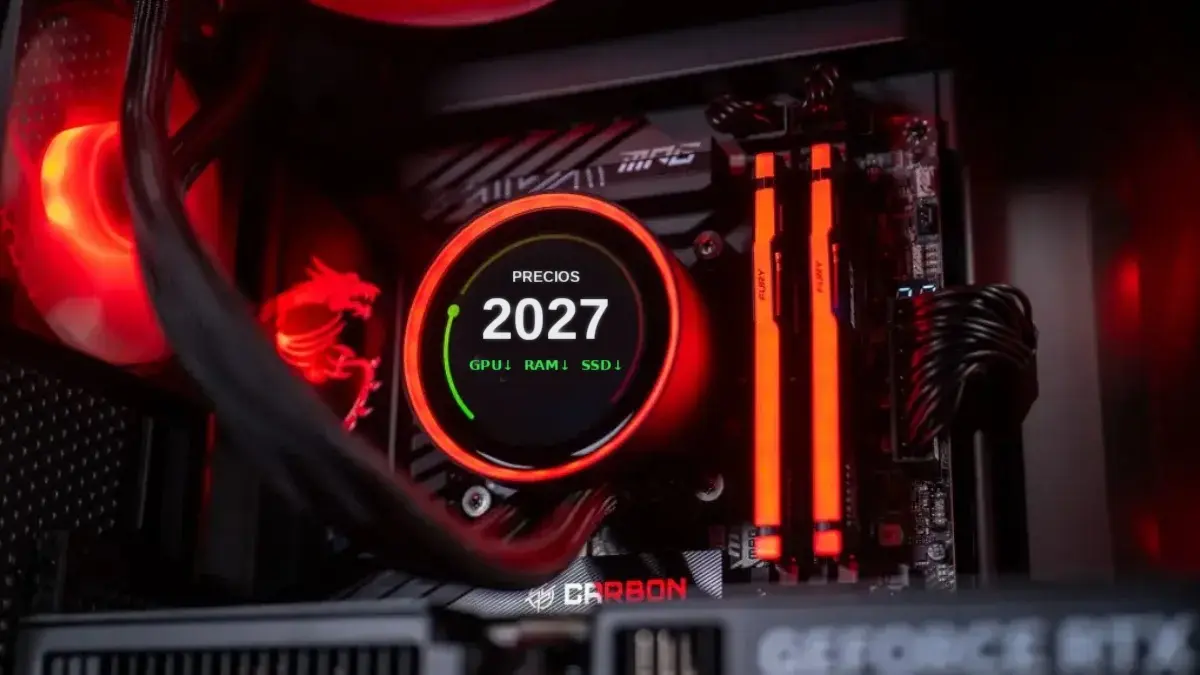
After two years during which a 32 GB DDR5-6000 RAM kit went from costing about $130 to at least $500, the PC hardware market is beginning to show signs of relief, because according to GameGPU RAM and SSD prices have started to ease, graphics cards would have likely peaked and everything indicates that these components would decrease in price in 2027, a year that looks much brighter for those who want to build or upgrade their gaming PC.
The shift comes because the big artificial intelligence customers, who were responsible for driving prices up, are cutting back their purchases of graphics cards, and some announced data centers will never be built, amid a cooling of the bubble visible in the stock market, where NVIDIA collapsed 42% in just three weeks.
Why graphics cards would drop in price in 2027
According to retail sources cited by GameGPU, GPU prices will remain high during the year-end holidays but without new significant increases, and the first improvement is seen in the rising shipments of the RTX 5080 in November, in a scenario the outlet compares to what happened in late 2021, just before cryptocurrency mining collapsed and graphics cards returned to stores.
The comparison is not minor, because when cryptocurrency mining collapsed in 2022 thousands of used graphics cards flooded the market and prices of new ones fell in a few months, something that today could repeat if the data centers that are canceled stop absorbing production that used to be shipped in full boxes.
Memory manufacturers’ shares plunge
The stock market clearly reflects the end of the euphoria, because Micron, one of the world’s three major RAM manufacturers, fell 13% this Friday to around $603 and stood 50% below its June record, while the day before Samsung fell 7.01%, SK hynix 5.92%, Western Digital 11.89% and SanDisk 14.26%, in a mass sale of AI-related stocks that left SK hynix down 21% in a single week.
Behind the collapse there are several reasons that converged, such as the leadership crisis at NVIDIA after Jensen Huang’s departure, stricter rules for exporting chips from the United States, fears that data center construction will stall and the class action against Micron, Samsung and SK hynix for withholding memory production to push prices higher, though it should be noted that these companies continue to make money like never before, because Micron just closed six consecutive quarters of record revenues, so the drop in the stock price does not immediately translate into lower store prices, but it does show that investors are betting the era of expensive memory is about to end.
The smuggling of graphics cards into China
Another reason that could push prices down is the United States’ crackdown on the smuggling of NVIDIA chips into China, a real issue that reached courts with cases such as a California entrepreneur accused of exporting around $300 million in NVIDIA gear through Malaysia and Singapore, or three men arrested in Singapore for a fraud of about $390 million with servers that could carry chips from the brand.
Employees of stores like Newegg, Amazon and Micro Center also report suspicious orders, such as pallets of graphics cards sent to industrial parks that have nothing to do with gaming, or resellers who pay tens of thousands of dollars in cash, and GameGPU estimates that if the United States manages to cut that channel in the next 12 months, that diverted stock would gradually return to stores for gamers.
SSDs are the first to drop in price in 2027
Storage is showing the clearest drop, because the consultancy TrendForce revised its forecast for the last quarter of the year from a rise of 15 to 20% to only 8 to 13% in NAND memory contract prices, which is what SSDs use, and now expects those prices to fall 0 to 5% between January and March 2027 before entering a downtrend across all categories starting in April.
The decline is also evident in the spot market, where according to Xenospectrum the price of 512 Gb NAND wafers fell 23.3% in just three weeks since mid-November, although the Korean daily Seoul Economic Daily warned that it is still too early to ensure that that drop has translated into contracts signed by SSD manufacturers, so the impact in stores should be seen more strongly starting in January.
RAM would also drop in price in 2027, even if manufacturers say otherwise
RAM is the most debated point, because Samsung claims that memory scarcity will be worse in 2027 and extend into 2028 and that it has sold all its AI-focused HBM memory production for next year, a claim that must be taken with caution given who is making it.
According to reports from Korean media cited by SamMobile, Samsung would have committed up to 70% of its memory production capacity in long-term contracts through 2031 with customers such as NVIDIA and Microsoft, a strategy that ensures profits for years but leaves much less memory available for PC, notebook and console manufacturers used by gamers.
Samsung, Micron and SK hynix face a US lawsuit for manipulating RAM production to keep prices high, where they are accused of cutting conventional memory output while focusing on HBM, a conduct that, according to the plaintiffs, helped memory prices rise by a 697% in 18 months, and the judge rejected the three companies’ request to dismiss the case.
The case has just begun and no liability has been established, but the three firms, which according to the complaint accounted for more than 91% of DRAM revenue worldwide, must respond by the latest 7 December and the first hearing is set for 12 January 2027, so the trial could advance right in the months when memory prices for the next year are defined.
What is worth buying now and what to expect
With current data, the SSD is the piece you can buy with confidence first, because NAND contract prices would hit their lowest point between January and March 2027, while with the graphics card the most sensible move is to wait until after the holidays, when year-end sales finish and shipments of models like the RTX 5080 began to rise in November.
RAM is the hardest bet, because if the manufacturers are right it will stay expensive until 2028, but if demand in the United States picks up and data centers buy less, the pressure could force Samsung, Micron and SK hynix to release more production for the consumer market, so those who are not in a hurry might wait to see what happens at the January hearing before paying current prices.
It’s Worth Waiting Until 2027 to Build a Gaming PC
The recommendation from experts cited by GameGPU is not to buy at current prices and to wait until 2027, when AMD and NVIDIA would also begin withdrawing their current lines to make way for new generations, a combination that, along with fewer data-center orders and the crackdown on smuggling, could return prices to gamers that haven’t been seen since before the AI boom.
The same trade sources cited by GameGPU also claim that the RTX 5090 could stop being manufactured during 2027 and that the future RTX 6090 would arrive between late 2027 and early 2028 with an estimated price between $2,500 and $3,000, although NVIDIA denied the information and several specialized outlets look at it with suspicion, so for now it’s only a rumor to be treated with caution.
