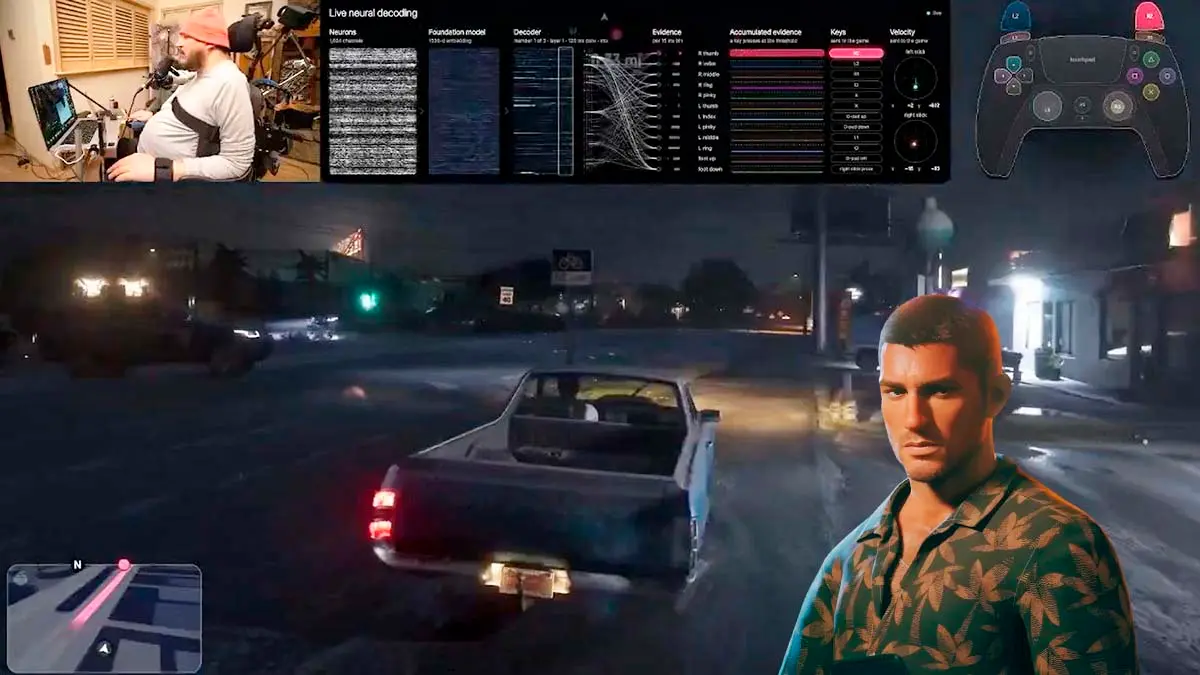
A participant in Neuralink’s clinical trials has left the entire world astonished by demonstrating that it is possible to play GTA 6 with the mind, without using any physical controller, steering the entire action on screen solely with the power of their thoughts.
A new demonstration that, for many, marks a turning point in the history of assistive technology, because it confirms that a person with severely reduced mobility can immerse themselves in and enjoy one of the biggest, most complex, and dynamic video games ever created using only their thoughts, completely removing the barriers of traditional controls and restoring digital independence that until recently seemed to belong to science fiction.
From imagining a physical movement to pressing a virtual button
Through a video posted by the company on the social network X, the anonymous user can be seen moving with complete ease across the game’s gigantic map, while piloting a speedboat on the water, flying a seaplane, and driving cars at full throttle, engaging in intense close-quarters combat.
While all this action unfolds in real time, an overlaid graphic on the screen shows how the buttons and joysticks on a DualSense controller light up and move instantly thanks to electrical signals emitted directly from the brain, demonstrating a level of fluidity and response speed that is truly impressive for such a demanding, detail-rich open-world title.
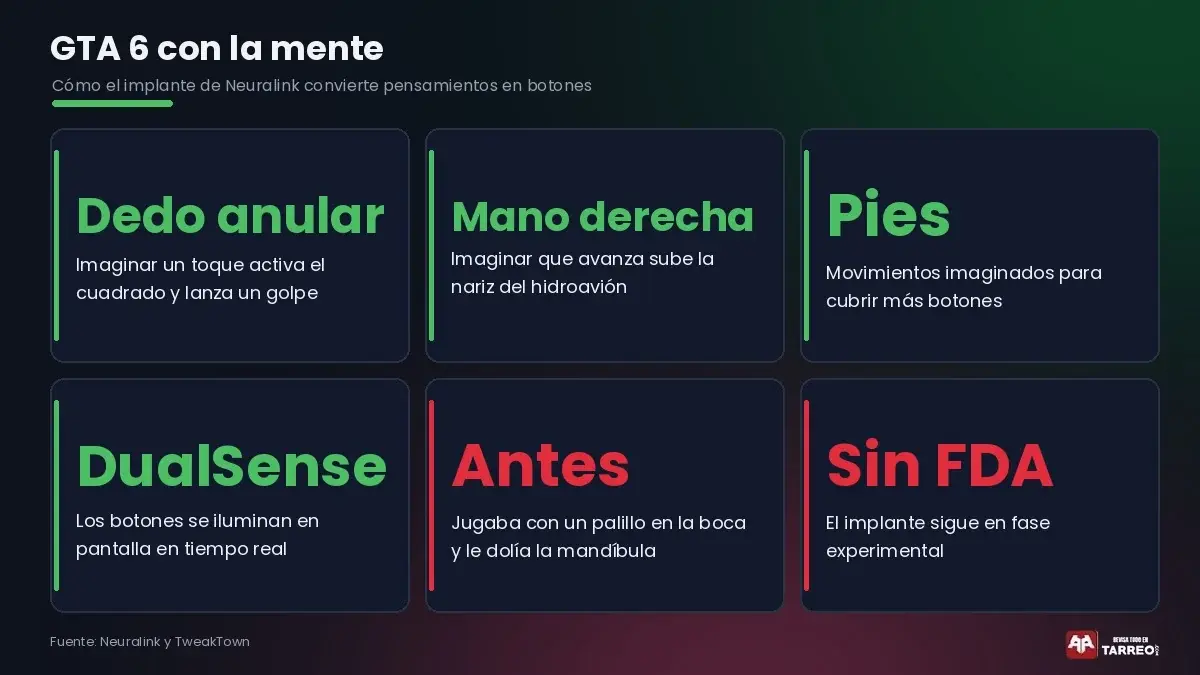
Before undergoing surgery to receive this innovative device, the participant’s digital life and entertainment were extremely limited, frustrating, and physically exhausting, because they depended entirely on a special stick held in their mouth to touch the tablet’s screen little by little.
This experience, described by him in the video, felt to him exactly like a bird tirelessly pecking at the glass of a screen, a daily routine that left his jaw muscles badly sore and fatigued after only a short time of use. However, immediately after receiving the brain implant and turning on the system, the change in his quality of life was radical and nearly instantaneous, allowing him to reclaim what he emotionally calls his true window to the outside world.
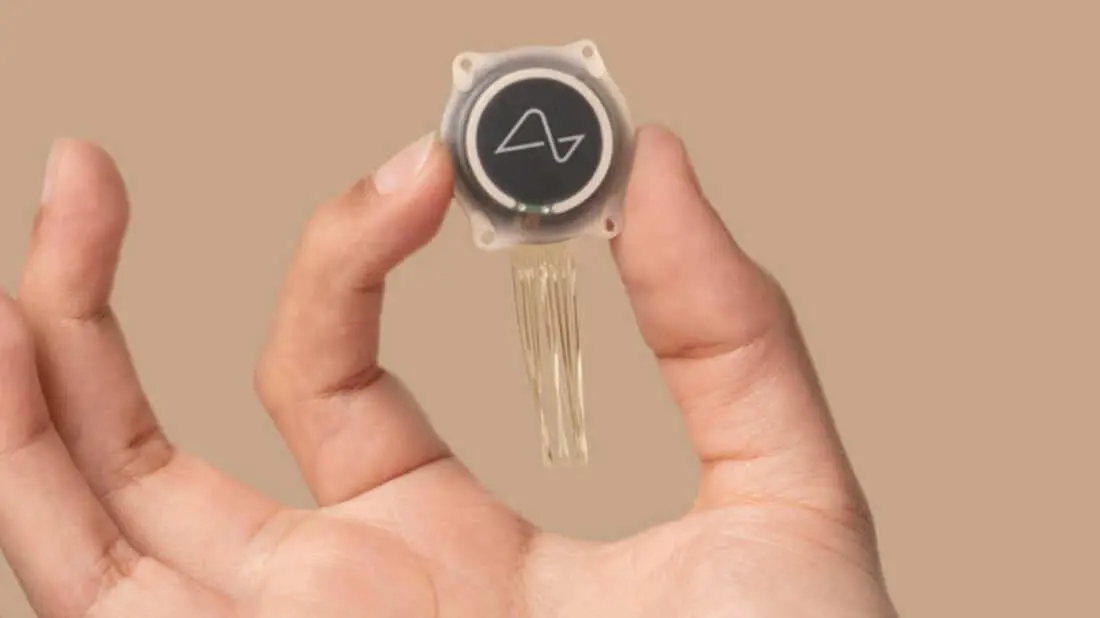
The secret behind this incredible technological feat lies in the brain implant developed by the company and known as Telepathy, a tiny chip placed with extreme precision in the part of the brain responsible for planning and controlling body movement. This device has the ability to read and interpret the electrical signals emitted by neurons precisely at the moment the user imagines moving a body part, regardless of whether their actual muscles can perform that physical command.
To achieve such detailed control in a game as expansive as GTA 6, the engineering team configured multiple custom commands based on very natural imaginary movements for the user. For example, when the player simply thinks about giving a light tap with their ring finger, the system detects that neuronal intention and immediately activates the square button on the controller to land a strike in the middle of a fight, while if they envision sliding their right hand forward, they manage to raise the nose of the seaplane mid-flight with smooth precision.
In addition, to cover a broader range of buttons and actions required by a game of this scale, specialists also programmed the system to recognize imagined movements with the feet, all while a live control panel next to the video shows how brain waves are translated instantly into clean and exact digital commands.
The journey so far and the precedent set by Noland Arbaugh
This astonishing achievement with GTA 6 does not represent Neuralink’s first success in the realm of digital entertainment, because previously other participants in the clinical trials had demonstrated that the chip could handle everything from very fine, precise movements like those of a computer mouse to fast-paced, dynamic racing in games such as Mario Kart.
However, the most emblematic and widely cited case that opened the door to this revolution is that of Noland Arbaugh, who was 29 years old when he received the implant and whose life was irreversibly changed after a serious accident that fractured his C4 and C5 vertebrae, leaving him tetraplegic with no mobility from the neck down and forcing him to abandon video games, a pastime that had always been his greatest passion.
For Noland, becoming one of the pioneers testing this technology required many hours of patience and constant practice to train his mind, focusing on visualizing the movement of his hands over and over until he could move the cursor with thought in a natural, effortless way.
Thanks to his enormous dedication and the ongoing improvement of his connection to the implant, Noland astonished the world by returning to play complete chess games moving the pieces on the board without touching anything, and later mastering much deeper, longer, and more demanding strategy games like Civilization VI, proving for the first time that the technology worked wonderfully in real-life, everyday situations.
In conclusion, it is noted that each patient has a unique brain and may respond differently to the adaptation process, and that these clinical trials are still in their early stages. Neuralink clarifies that the device is experimental, not FDA-approved, and that results vary, so there remains a significant journey ahead before this solution reaches all hospitals, although seeing someone transition from relying on a painful mouth-held stick to controlling a vast virtual world demonstrates how quickly this innovation is advancing.
