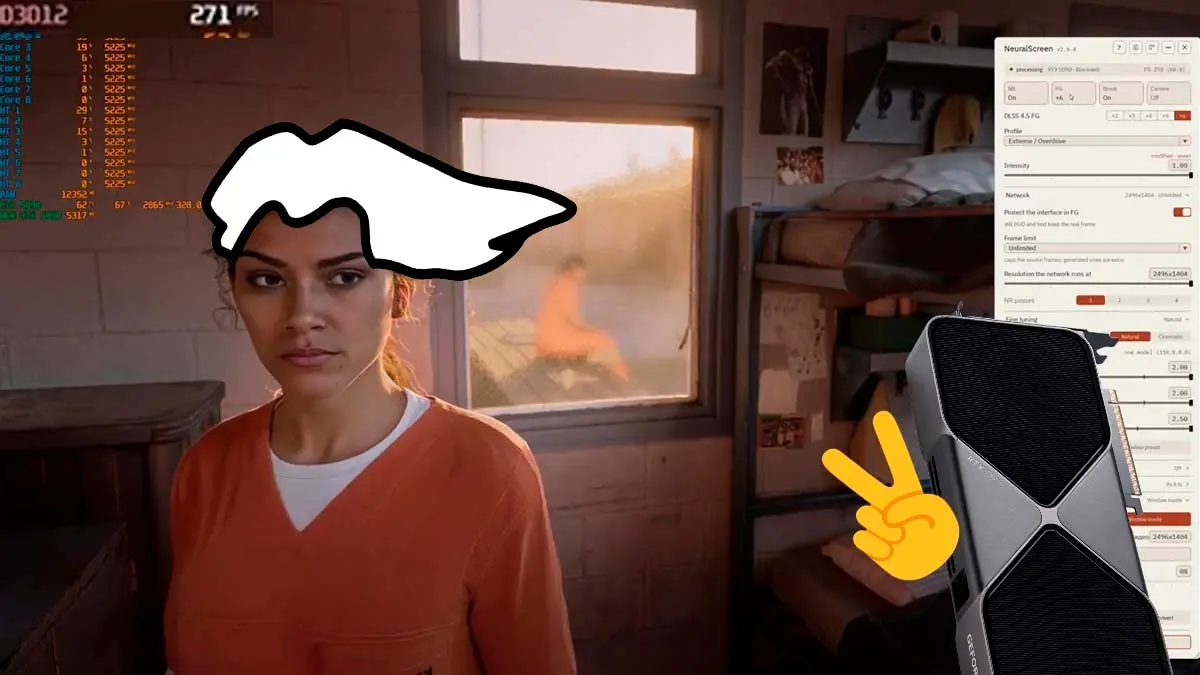
Technological progress never stops amazing gamers when it comes to squeezing the most out of graphics and screen smoothness. Recently, the outlet GameGPU conducted a striking technical test using a PS5 Pro running Grand Theft Auto 6 connected to a high-end PC, equipped with an NVIDIA GeForce RTX 5090 graphics card and an AMD Ryzen 7 9800X3D processor, with which they managed to show GTA 6 at 280 FPS on screen.
By the coordinated use of an external video capture device, the PC with the RTX 5090 and artificial intelligence programs like NeuralScreen, they managed to intercept the console’s signal to transform the 30 original frames into an ultra-smooth experience that fluctuated between 262 and 280 frames per second, with peak values of 286 FPS in 4K, while simultaneously enhancing visual aspects such as skin, hair, Lucia’s prison outfit, and ambient lighting, without pushing the graphics card to its absolute limit.
The difference between watching GTA 6 at 280 FPS and the real system response
As we mentioned, to achieve this connection a special video capture card called AVerMedia Live Gamer ULTRA 2.1 was used, which sent the entire signal directly to the OBS Studio program installed on the PC. In this digital environment an unofficial application named NeuralScreen came into play, responsible for applying in real time the advanced DLSS 5 algorithms together with 6X DLSS 4.5 frame generation.
Although seeing GTA 6 at 280 FPS is truly stunning at first glance, it is essential to understand that the game is not running natively at that speed, because the PS5 Pro console continues to process the title independently of its usual 30 frames per second.
The magic behind this technical showcase lies in the DLSS 4.5 technology in its 6X mode, which is responsible for inventing five artificial frames through artificial intelligence for each real frame it receives from the capture signal, creating an optical illusion of extreme smoothness that favors the human eye but does not provide any real improvement to gameplay.
In addition to this visual deception, the process of sending the signal through a capture card and a computer adds an input latency that affects the immediacy of actions, a technical detail that GameGPU did not measure in their test.
During this demanding operation, the powerful RTX 5090 graphics card operated between 62% and 75% of its total capacity, consuming between 305 W and 368 W of power, while when only enabling the function to generate extra frames the power draw and demand dropped dramatically to stay at 37% or 40% of load, demonstrating that the most significant effort falls on the advanced AI filters.
The real performance on Sony consoles and the final conclusion
Setting aside extreme experiments on high-end PCs, and as we reported just hours ago, the technical analysis by Digital Foundry revealed the reality of how the title runs on PlayStation consoles, confirming that GTA 6 runs at 30 frames per second on both machines, but the standard PS5 suffers worrying drops down to 23 FPS during the most chaotic encounters packed with explosions and fast-paced chases.
Although in everyday scenarios the base model manages to maintain the target set by Rockstar Games, these sudden performance dips occur precisely at the moments when stability is most needed to aim precisely, move the camera, and control vehicles.
Conversely, the PS5 Pro offers a much higher experience by keeping its 30 frames per second almost entirely stable during more than 50 hours of exhaustive testing, briefly dipping to 24 FPS only when massive explosions were intentionally triggered.
In conclusion, although both versions process a similar base image, the PS5 Pro leverages the intelligent upscaling PSSR to achieve sharpness almost identical to real 4K and adds ray-traced shadows that are absent in the standard model, though it remains far from the fluidity of GTA 6 at 280 FPS achieved by routing its signal through a PC with an RTX 5090.
