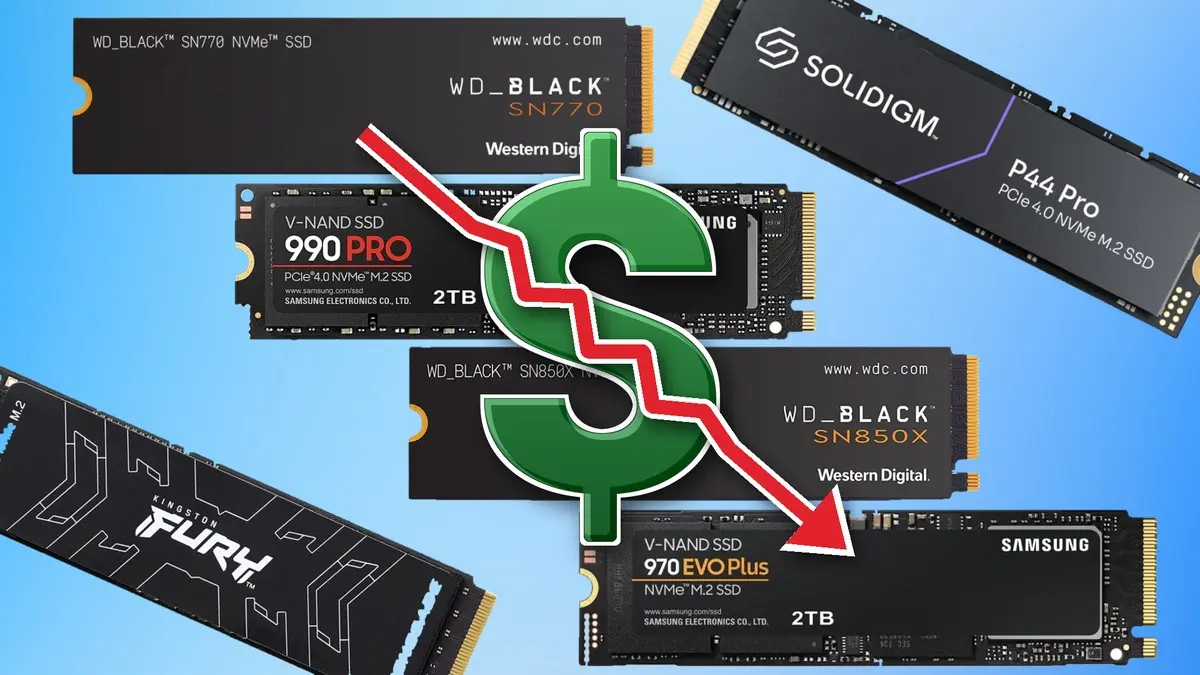
The price of NAND memory, the chips where SSDs store your games and files, has fallen by about 20% in just one month in the spot market, which is where manufacturers and distributors buy memory on a day-to-day basis, and Bank of America expects the decline to continue with another drop of 5% to 10% in contracts for the first quarter of 2027, according to Tom’s Hardware, which cites a report from the South Korean daily Seoul Economic Daily. The sharpest drop was seen in the 512 Gb wafers, the silicon plates from which memory chips are made, which fell 32% to $14.30 each, and this marks the first sign of relief for SSDs after months of AI-driven price increases.
The decline comes as consumer technology sales slow, because rising prices prompted many to postpone purchasing laptops, phones, and components, while memory production continues to grow and competition from Chinese manufacturers like YMTC adds more supply. According to TrendForce, traders in China are rushing to dump their inventories as demand is seen as even weaker for 2027, and that accelerated the fall of NAND memory by as much as 20% in just two weeks.
When the NAND memory price drop could be noticeable in SSDs
The 20% drop is in the spot market, which is the first and fastest to move, while SSD manufacturers buy most of their memory through contracts that are negotiated quarterly, and thus relief does not reach stores immediately. Bank of America expects the contracts for general-use NAND memory, the kind that goes into consumer SSDs, notebooks, and phones, to fall between 5% and 10% at the start of 2027, and TrendForce agrees that memory is entering an oversupply period, with contract prices starting to fall in the second quarter of 2027 and decreasing further in the second half of the year.
In practice, that means the SSDs sold today were manufactured with NAND memory bought at higher prices, so the decline should become noticeable gradually during the first months of 2027, as manufacturers renew their contracts and stores liquidate their inventories. If you need more space for your games now, there’s no reason to wait months, but if you can postpone buying a large SSD, the coming months should work in your favor.
Why RAM doesn’t drop as NAND memory does
The drop in NAND memory does not reach all SSDs, because models for enterprise and data centers continue to rise, and TrendForce projects that their contract prices will increase by 15% to 20% this quarter, driven by AI servers. That difference shows memory is bifurcating into two markets, a cooling consumer market and an enterprise market that keeps pushing prices higher.
RAM also does not follow the same path, because Bank of America expects DRAM to rise by about 8% this quarter and another 5% at the beginning of 2027, amid strong demand from data centers, a trend that has Samsung, Micron, and SK hynix facing a lawsuit over RAM production and pricing. Therefore, if you’re building a PC, storage should be the first component to come down in price, while RAM will remain expensive for a while longer.
