The world of consoles lives in a constant tug-of-war between the barriers set by manufacturers and those who seek to push beyond them, and in this landscape it has just emerged that PlayStation paid $50,000 to a hacker for reporting a flaw in the PS5 that allowed Linux to be installed on the console, a decision that drew strong criticism from the hacking community itself.
The hacker, known on X as Jordy, found a critical flaw in the PS5 hypervisor, the security layer that governs what can run on the console, and reported it to Sony’s bug bounty program via HackerOne, which pays its maximum reward only for the most severe flaws, according to Tom’s Hardware.
Why the hackers did not forgive revealing the flaw
What bothered the community most was that Jordy was not the first to uncover this flaw in the PS5, since Andy Nguyen, known as TheFloW, one of the most well-known PlayStation hackers, had discovered it earlier and had been using it for his project to bring Linux to PS5, which would let the console function as a computer without losing access to games.
Nguyen planned to keep it secret until after the release of GTA VI, on November 19, because the game would require a newer firmware, and exposing the flaw beforehand would likely lead Sony to patch it and unlocked consoles would be unable to play it without losing the unlock. Jordy had agreed to wait, but ultimately reported it once he learned that another researcher had found it with the help of artificial intelligence.
“I decided to report it, because if another person and I could find it with an LLM, anyone can do it,” Jordy explained, noting that he also used AI to detect the flaw.
The community’s reaction and the consequences
The decision was very poorly received among hackers, since the community had itself raised more than $37,000 as a reward to keep the flaw from being disclosed, though neither Jordy nor Nguyen accepted it, and after the disclosure Nguyen announced that he was leaving the PS5 scene and abandoning his Linux project, including the PS5 Pro support he had planned for 2027, pointing at what he called “slop kiddies,” a dig at those who exploit AI to find vulnerabilities.
Jordy’s post drew over 1.8 million views, and the backlash followed quickly, with users like Gille posting “50k in the bank but zero friends, was it worth it?”, and others even suspecting that Nguyen had directed him to the location of the flaw, a claim Jordy denies, insisting that AI did the heavy lifting and that he still keeps private contacts with Nguyen.
The harshest attack arrived in private messages, as Jordy shared a screenshot of an abusive message directed at his mother, who Kotaku notes may have a terminal illness; while on X, other users accused him of depriving people of the chance to play GTA VI for free, with comments such as “you took GTA 6 away from everyone, and you show up with $50,000 saying that’s enough to buy the game”.
Rather than back down, Jordy replied that “people act as if I were a terrorist or something”, admitted that his joke about buying GTA VI with the money was deliberate to provoke, and insisted that he has no interest in helping pirate games, while there were also defenders who said things like “50k pays the bills, your opinion doesn’t”.
Sony fixed the flaw in the firmware 14.20, released on October 21, so updated consoles are protected, though Jordy warned that this will not be the last PS5 hypervisor flaw, a point that researcher Eric Parker agrees with, while reports of AI-identified vulnerabilities have overwhelmed the reward programs, to the extent that Google paused its program until 2027.
The PS5 turned into a computer to run Steam
In another line of work, but with the same objective of squeezing more out of the console, a group of independent developers managed to turn it into a machine capable of running Steam games natively, without streaming or cloud access from another computer.
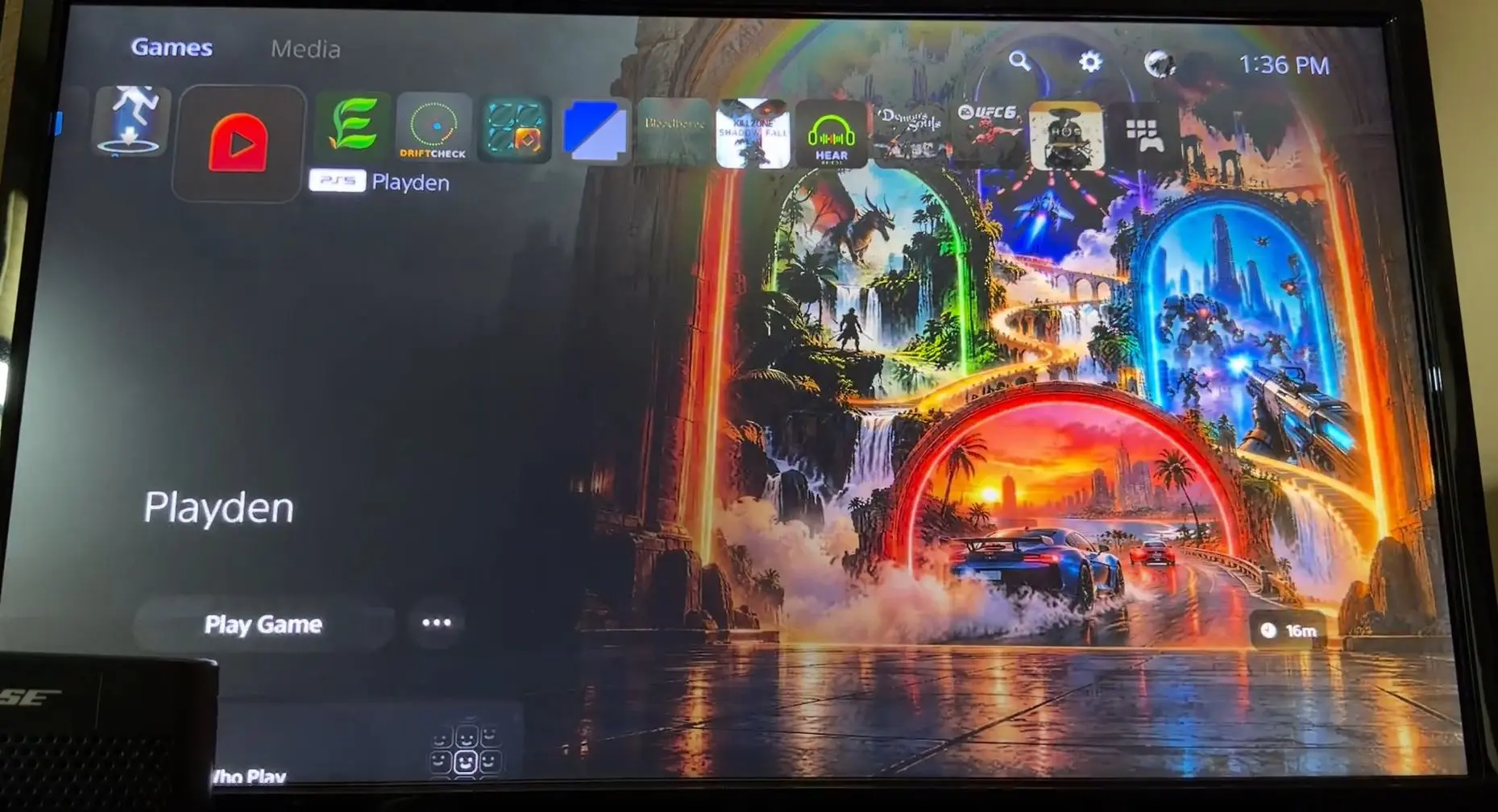
This achievement was made possible thanks to the Playden project and its tool prospero-win, adapted specifically for PlayStation hardware, which allows signing into Steam, downloading games, and running them directly on the console as if they were official apps.
But, as we noted in this article, despite being a fascinating advance, the process still faces graphical performance issues, sudden crashes, and configuration steps that are too complex for the average user.
In the end, all of this makes clear the ongoing tug-of-war between manufacturers and the community striving to unlock consoles, where artificial intelligence accelerates flaw hunting, and where every vulnerability reported ends up closing a door that other hackers would have preferred to keep open.