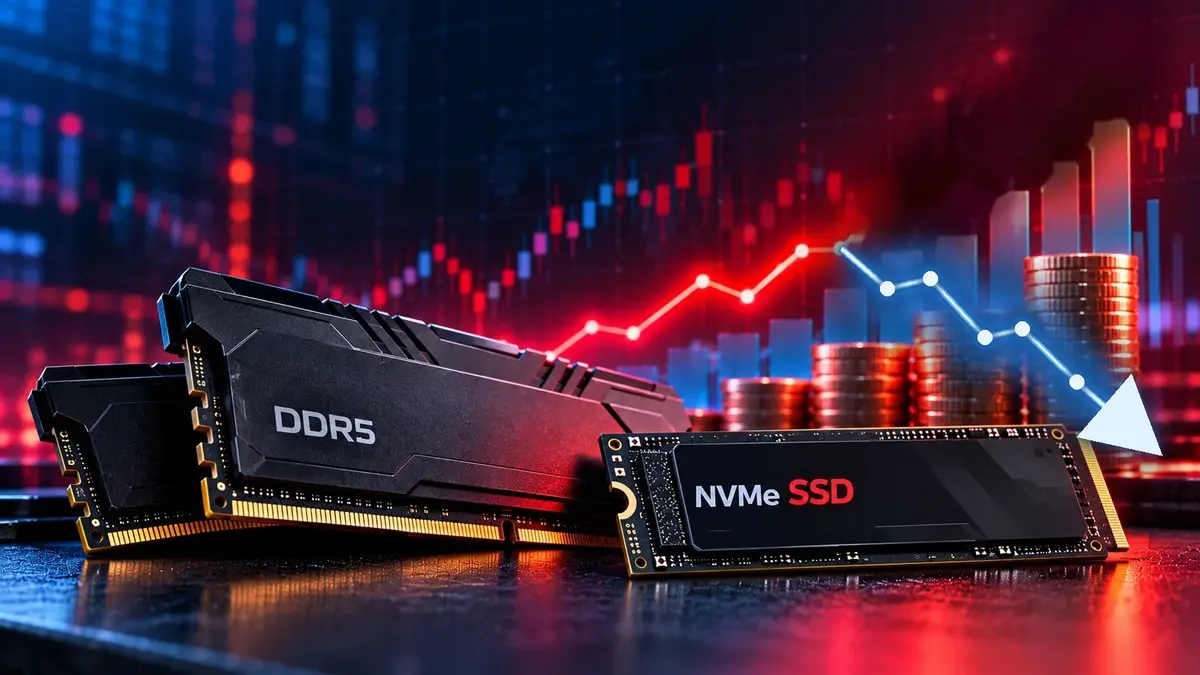
After a 2026 in which a 32 GB DDR5 RAM kit went from costing around $130 to at least $500, the South Korean firm BNK Investment & Securities published a report predicting a dramatic drop in RAM and SSD prices by mid-2027, because distributors and PC manufacturers bought so much memory for fear of shortages that their warehouses are now full, and when they begin to clear them, new orders will suddenly slow to a halt.
The author of the report is the analyst Lee Min-hee, who asserts that actual demand for memory peaked in the second quarter of this year and that customers would start trimming inventories between the second and third quarters of 2027, just as prices would fall visibly, a piece of good news for gamers who have been delaying the purchase of RAM or a SSD for their gaming PC.
Why RAM prices would drop in 2027
The report’s key lies in an imbalance between what is manufactured and what is actually used, because according to Lee Min-hee this year demand for DRAM would rise by 24% while manufacturers’ shipments would jump by a 38%, the largest increase since 2016, meaning that a substantial portion of the memory that left factories did not end up in computers or phones but was stored in warehouses.
This surplus is explained by the crisis, during which many buyers stockpiled memory for fear of shortages, while high prices led several PC and mobile manufacturers to install less memory in their devices, postpone orders, or pass the cost on to consumers, a combination that stifled hardware sales and left the industry with more memory than it can sell.
According to BNK, PC RAM and the NAND memory used in SSDs are the most sensitive to this inventory overhang, so they would be the first to drop when computer makers begin to clear their warehouses, translating into cheaper DDR5 kits and NVMe SSDs for gamers.
This would not be the first time such a pattern occurs, because after the pandemic the industry experienced a similar cycle, when PC and mobile manufacturers were left with warehouses full of memory bought in excess and the RAM price collapsed during 2022 and 2023, to the point that SK hynix posted quarterly losses for the first time in a decade and Samsung had to announce production cuts in April 2023 to curb the decline.
SSD prices would also fall
The BNK forecast aligns with what is seen in the storage market, because consulting firm TrendForce lowered its projection for the fourth quarter of the year from a rise of 15 to 20% to only 8 to 13% in NAND memory contract prices, and now expects those prices to fall 0 to 5% between January and March 2027, while the price of 512 Gb NAND wafers fell 23.3% in just three weeks since mid-November.
SK hynix, the big loser
The forecast hit SK hynix, one of the world’s three major RAM manufacturers, because BNK cut its price target for the stock by 36.4%, from 1,650,000 to 1,050,000 won, about $780, even as the company has fallen 62.7% from its all-time high, and BNK also lowered its earnings forecast for 2027 by 12%.
Perhaps the most striking aspect is the long-term projection, because BNK’s model foresees SK hynix’s operating profit plunging 89% in 2028, accompanied by an 85.9% drop in earnings per share, once the memory cycle driven by artificial intelligence that allowed record earnings this year ends.
The market seems to be validating BNK’s view, as this week the shares of memory manufacturers tumbled amid a broad AI-related selloff, with Micron down 13% on Friday, ending up 50% below its June peak, and SK hynix losing 21% in a single week, signaling that investors are betting RAM prices will stop rising soon.
Not all analysts agree that RAM prices will fall
BNK’s forecast is not universal, because another South Korean firm, KB Securities, still expects DRAM contract prices to rise by 40% in 2027 due to strong demand from servers and data centers, and Samsung asserts that memory scarcity will worsen in 2027 and persist into 2028.
The manufacturers’ version should be treated with caution, because Samsung, Micron, and SK hynix face a U.S. lawsuit alleging they manipulated RAM production to keep prices high, accused of cutting conventional memory production while focusing on HBM for AI, actions that, according to the plaintiffs, helped memory prices surge by 697% in 18 months.
Waiting to buy RAM and SSD is advisable
For now, prices in major electronics retailers remain unchanged, so BNK’s forecast is a signal rather than an immediate discount, but those not in a rush to assemble or upgrade their gaming PC have good reason to wait, especially with SSDs, which show the clearest decline and whose price would bottom out between January and March 2027.
With RAM, the wait would be longer, because if BNK’s analysis holds, the sharp drop would arrive only between mid-2027 and the third quarter of 2027, when PC manufacturers and distributors finish clearing their warehouses and stop buying new memory, forcing Samsung, Micron, and SK hynix to lower RAM prices to resume sales.
