
A Xbox executive stirred a huge uproar among players by asserting that artificial intelligence would enable the creation of high-quality games with teams of only two or three people. This is Brandon Stirrup, Xbox’s Senior Manager of Business Strategy, who posted a series of statements on X, according to Tech4Gamers, suggesting that two or three developers could complete a AA or AAA level game in just one year if they make good use of AI tools.
To back up his stance, Stirrup explained that he himself put together a “bad but improvable” game in two days using AI, and he also claimed that many Xbox employees use it in secret, which generated such a massive backlash that within less than 24 hours his X account was deactivated.
The controversial statements by the Xbox executive about AI
The Xbox executive published his unfiltered reflections on October 18, arguing that the video game industry is the only one delaying the transition to AI because users hold a negative opinion of it, unlike other sectors where its adoption is seen as a natural progression. To illustrate his point, he explained that he created a basic game in two days with about three hours of active work, using what is known as vibe coding.
For those unfamiliar with the term, vibe coding is a way of programming in which you do not write the code yourself, but you describe to an artificial intelligence what you want in plain language, for example, “make a platformer where the character jumps and collects coins,” and it generates the code for you. The person only reviews the result, asks for changes, and tests again, without needing to understand in detail how the AI wrote what it did. The term was popularized in 2025 by Andrej Karpathy, one of the founders of OpenAI, and while it enables rapid prototyping, many developers warn that the code it generates often contains bugs and is difficult to maintain in large projects, such as a AAA game.
In addition, Stirrup asserted that “there makes no sense to have a 5 to 10-year plan without AI in 2026,” since “everything you plan will be replaced,” and he added that those who do not integrate these tools are “planning a false future”. He also revealed that within Xbox many employees use it daily, but they keep it hidden because of the backlash it triggers among players.
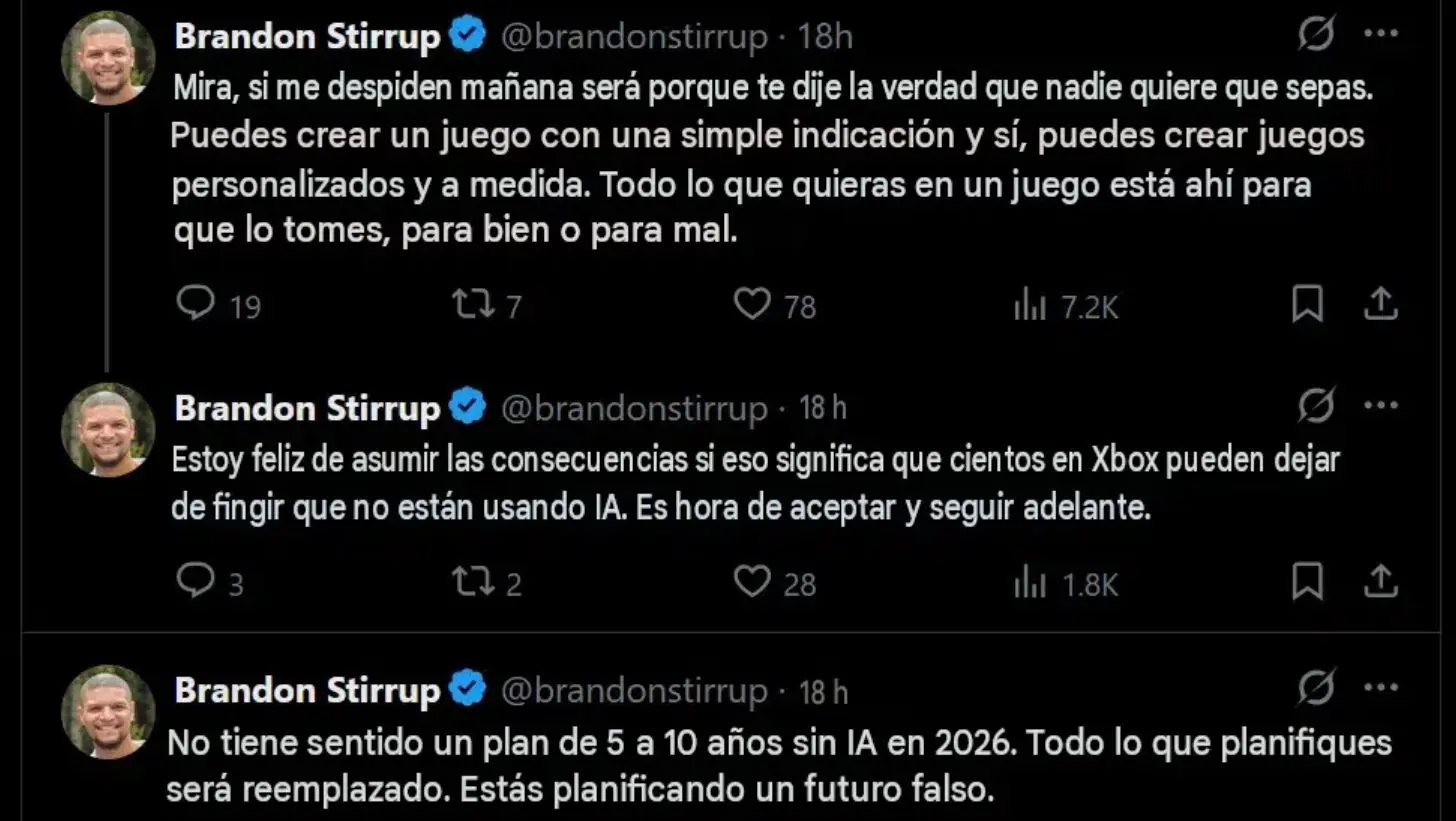
Consciente del malestar que provocarían sus palabras, manifestó de forma desafiante, con frases originalmente en inglés que recogió PC Gamer, que estaba “feliz de asumir las consecuencias si eso significa que cientos en Xbox pueden dejar de fingir que no están usando IA”, y agregó que “es hora de aceptar y seguir adelante”.
También defendió la accesibilidad de estas plataformas al escribir que “puedes crear un juego con una simple indicación y sí, puedes crear juegos personalizados y a medida”, y que “todo lo que quieras en un juego está ahí para que lo tomes, para bien o para mal”. Al mismo tiempo, se adelantó a las posibles consecuencias al afirmar que “si me despiden mañana será porque te dije la verdad que nadie quiere que sepas”.
Con estas palabras buscó dar por cerrada la discusión, rematando con que su objetivo era “terminar con esto para que podamos avanzar como empresa, a pesar de que algunos me persigan por esto”, y que “usamos IA, como todas las empresas en 2026”.
The Xbox executive closes his X account
Sin embargo, la reacción fue inmediata y mayoritariamente negativa, con jugadores y desarrolladores defendiendo que los juegos tienen un valor artístico que la IA no puede reemplazar, aunque sirva para que equipos pequeños trabajen más rápido. En menos de 24 horas, la cuenta de Stirrup desapareció de X, y según una fuente de Xbox citada por PC Gamer, la desactivó por la enorme cantidad de respuestas que estaba recibiendo.
Por ahora no se sabe si sus declaraciones tendrán consecuencias dentro de la compañía, y Microsoft no ha entregado ninguna declaración oficial sobre el tema. Lo que sí dejó claro esta polémica es que el uso de la IA en los videojuegos sigue siendo uno de los temas que más divide a los jugadores, sobre todo cuando se trata de reemplazar el trabajo creativo de los equipos de desarrollo.
