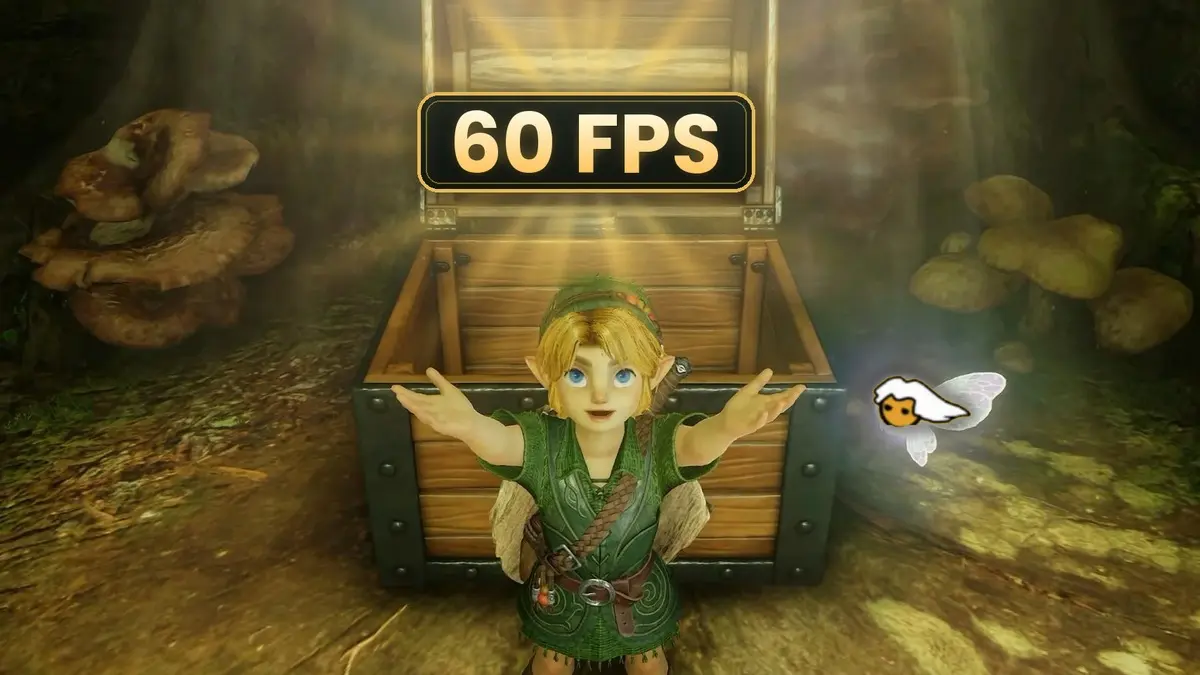
The Zelda Ocarina of Time remake for Nintendo Switch 2 finally runs at stable 60 FPS on PC, thanks to Fritchii version 6, a free Switch and Switch 2 emulator for Windows that is tuned especially for this game. Its creator, Frizti, calls it the project’s biggest update, with 840 changes and a single goal, to keep the remake at 60 FPS, and on his test PC he achieved it even in the Castle Town market, the game’s most demanding area, where it now reaches about 74 FPS without a cap, whereas before it hovered between 50 and 60 and rarely hit 60, according to the version notes on GitHub.
The novelty also reaches those with more modest setups, because GPUs with 8 and 6 GB get a special mode that keeps the game within its video memory to prevent stuttering, and in a test with an 8 GB card the game reached 67 FPS, enough to sustain 60. Version 6.1, released today, also adds a fix for the Vase Room in Castle Town, where video memory rose by about 4 GB, and it arrives at a critical moment, since the remake came out on November 5 and non-emulated ports of the game are still under development.
What changed in the Zelda Ocarina of Time remake with Fritchii 6
There are also fewer stutters during gameplay. The lag when defeating enemies occurs half as often, an object that isn’t ready yet now appears a moment late instead of freezing the game, and the Vase Room, which previously crashed the emulator, now runs smoothly. Additionally, those playing with the 60 FPS cap on 120 Hz or 144 Hz displays now see a steady image, without the little jump that used to appear every second, and in a 40-minute session in Castle Town the game stayed around 81 FPS without any crashes.
Visually, the emulator allows upscaling with DLSS on NVIDIA cards or FSR 4 on Radeon RX 9000, with outputs of 1080p, 1440p, 1800p, 4K, 2880p and up to 8K, although 8K requires 12 GB of video memory. Moreover, on AMD cards the pauses when an object first appears have disappeared and the red flashes on the water are gone, Intel Arc now work, though with issues, and for the first time there is a version for Linux.
What you need to play it on your PC
The Zelda Ocarina of Time remake requires a fast, recent processor to reach 60 FPS, a GPU compatible with Vulkan, and 64-bit Windows or Linux, and if your PC is more modest, the 30 FPS mode keeps the game running at full speed, according to Fritchii’s official page. The most important thing is that the emulator does not include the game, so you need your own copy of the remake taken from your console, along with your keys and the firmware for your Nintendo Switch 2.
Note that on 6 and 8 GB cards the resolution stays fixed at the game’s original resolution, even if you choose a higher one, and on the Steam Deck it runs at merely 10 to 12 FPS, far below what is needed. Reducing the resolution to 810p helps, but it’s not enough to play well.
How to download and install Fritchii step by step
- Go to Fritchii’s download page on GitHub and, in the Assets section, download the file Fritchii-v6.1-Windows-x64.zip, which weighs 71.4 MB. Do not download the files labeled Source code, because they do not include the emulator.
- Right-click the zip and choose Extract All. Put it in its own folder, for example in Documents.
- Enter the Fritchii-v6.1 folder and open the fritchii.exe file.
- Load your keys and the console’s firmware, and add the folder where you have your remake copy so that it appears in the list of games.
- Open the game. The first time, the emulator prepares the shaders, and that takes about 15 minutes on a fast 8-core processor, or longer on a 6-core or a notebook. Wait without closing it, because that step is what prevents stuttering later. If the game crashes while loading the first area, open it again.
- If you have an NVIDIA card, you can enable DLSS in the Upscaler option, just below Resolution. If the image shakes, uncheck the DLSS jitter option.
If you have been using Fritchii since version 4, you don’t need to download anything, because the emulator offers the update as soon as you open it. When upgrading from version 5, it will ask you once to delete the old shaders, and it’s safe to accept, because the emulator will recompile them automatically. On Linux, the emulator comes as an AppImage file, which updates itself just like on Windows, and if you have an Intel processor with performance and efficiency cores and the game runs at half the expected speed, the developer himself recommends typing EDEN_HYBRID_CORES=0 in the Tools > Switches menu.
If you prefer to play the Ocarina of Time remake without an emulator, the PC ports are still in development and you can keep up with them on Steam’s PC ports page, where they have gathered around 1.46 million downloads, while a community project is working on an online cooperative mode that runs precisely on Fritchii.
